
Claim at 62: About 70%
You can claim as early as 62, but your monthly check is permanently reduced — about 70% of your full benefit if your Full Retirement Age is 67.
Free, no-pressure Medicare guidance
Social Security
Claim at 62, at your Full Retirement Age, or at 70, and the difference is permanent. The timing also affects your Medicare enrollment and premiums, which is why we help people line up both decisions together.
The biggest choice
Your monthly benefit is set by when you claim, as a percent of your full amount. These figures assume a Full Retirement Age of 67 — the age for anyone born in 1960 or later.
You can claim as early as 62, but your monthly check is permanently reduced — about 70% of your full benefit if your Full Retirement Age is 67.
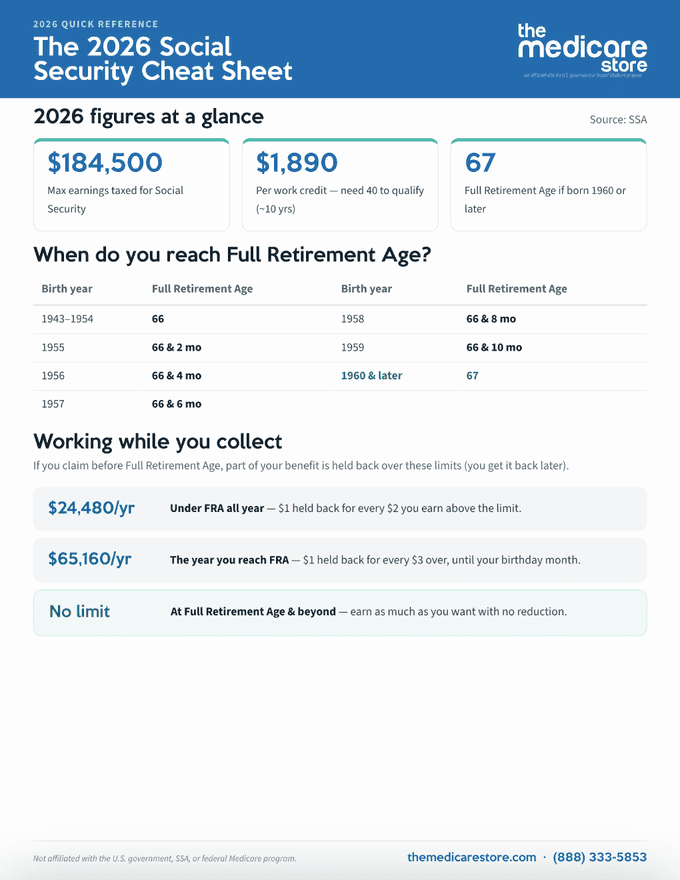
Your Full Retirement Age depends on your birth year — it's 67 for anyone born in 1960 or later. Claim here and you receive your full benefit.
Past Full Retirement Age, your benefit grows about 8% a year until 70 — about 124% of your full amount. There's no benefit to waiting beyond 70.
Working while you collect
If you claim before Full Retirement Age and keep working, part of your benefit is held back once you earn past these limits. It isn’t lost — it comes back later — but it surprises a lot of people.
Under Full Retirement Age all year. $1 is held back for every $2 you earn above the limit. You do get the held-back amount added to your benefit later.
The year you reach Full Retirement Age. The limit is higher and gentler — $1 held back for every $3 over, and only until your birthday month.
At Full Retirement Age and beyond. Once you reach Full Retirement Age, you can earn as much as you want with no reduction to your benefit.
Spouses and survivors
Married, widowed, or divorced — Social Security has rules that can change which strategy makes sense.
A spouse can receive up to 50% of the other spouse's full benefit, if that's more than their own. Which of you claims first, and when, changes the math for both of you.
A surviving spouse can receive up to 100% of a deceased spouse's benefit. This is one of the strongest reasons the higher earner often benefits from waiting.
You may still qualify for benefits on an ex-spouse's record if the marriage lasted at least 10 years — without affecting their benefit at all.
Where Medicare comes in
The two programs are connected — but they are separate decisions with separate deadlines. Getting one right and the other wrong can cost you for years.
Most people should still enroll in Medicare at 65 — even if they delay Social Security — to avoid lifelong late penalties. Waiting on one doesn't mean waiting on both.
Once you collect both, your Medicare Part B premium is usually deducted from your Social Security benefit — so the two decisions land in the same monthly number.
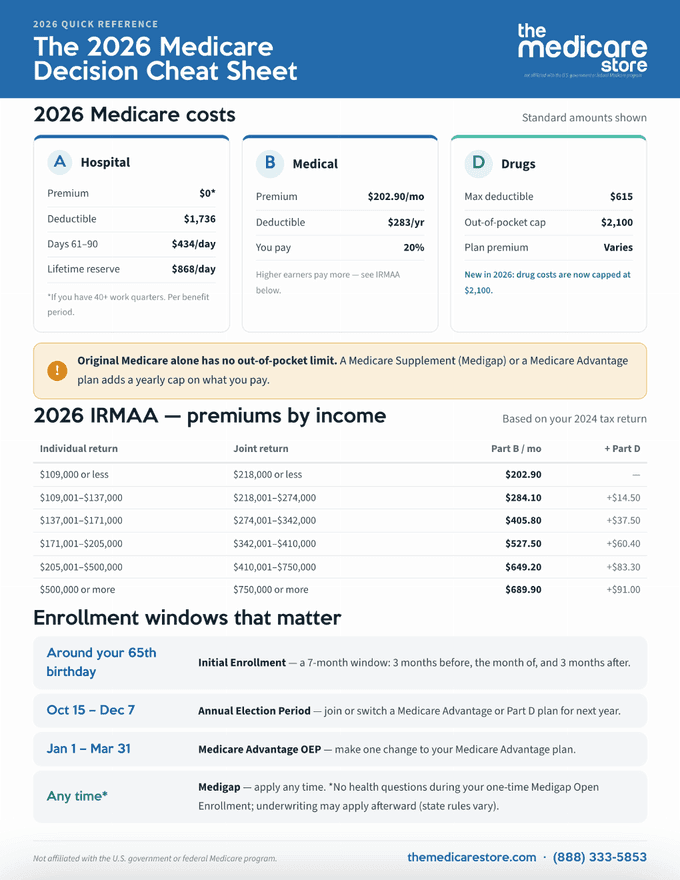
Medicare's IRMAA surcharges look at your income from two years prior. When you claim — and what you withdraw from retirement accounts — can quietly raise your future Medicare premiums.
Free download
All of these numbers on one page — Full Retirement Age by birth year, the claiming-age chart, the earnings limits, and how it connects to Medicare. Enter your name and email below and we'll send it to you. You can grab the Medicare edition too, or both.
Line up both decisions
A conversation with a licensed advisor is free, there's no pressure, and we're licensed in all 50 states. Start with your Full Retirement Age, then let's talk timing.
General information only — always confirm your benefit with the Social Security Administration. 2026 figures sourced from SSA. Not affiliated with the U.S. government, SSA, or federal Medicare program.